My research focuses on understanding how star formation happens, both in individual clusters and across entire star-forming complexes. How do clusters grow and evolve? How do populations interact with one another, and with their gaseous environments? Is there any order to the cluster formation inside a giant molecular cloud? And how can we improve our strategies of determining the age of a cluster?
To try and answer these questions, I combine observational data with computational methods (meaning I do a lot of coding) to study young stellar populations in the solar neighborhood.
Star formation histories in the solar neighborhood
I investigate the stellar populations of nearby molecular cloud complexes, in particular the Orion region, to discover how star formation has progressed across it over the past few million years. For this project, I am continuing the development of the machine learning-based clustering algorithm SigMA, short for Significance Mode Analysis. This algorithm is specifically designed to handle the millions of star measurements provided by the Gaia survey and to use them to identify and characterize stellar groups in the solar neighborhood. It will allow us to disentangle populations and discover patterns in their formation history.
Kinematics of Young Stellar Objects
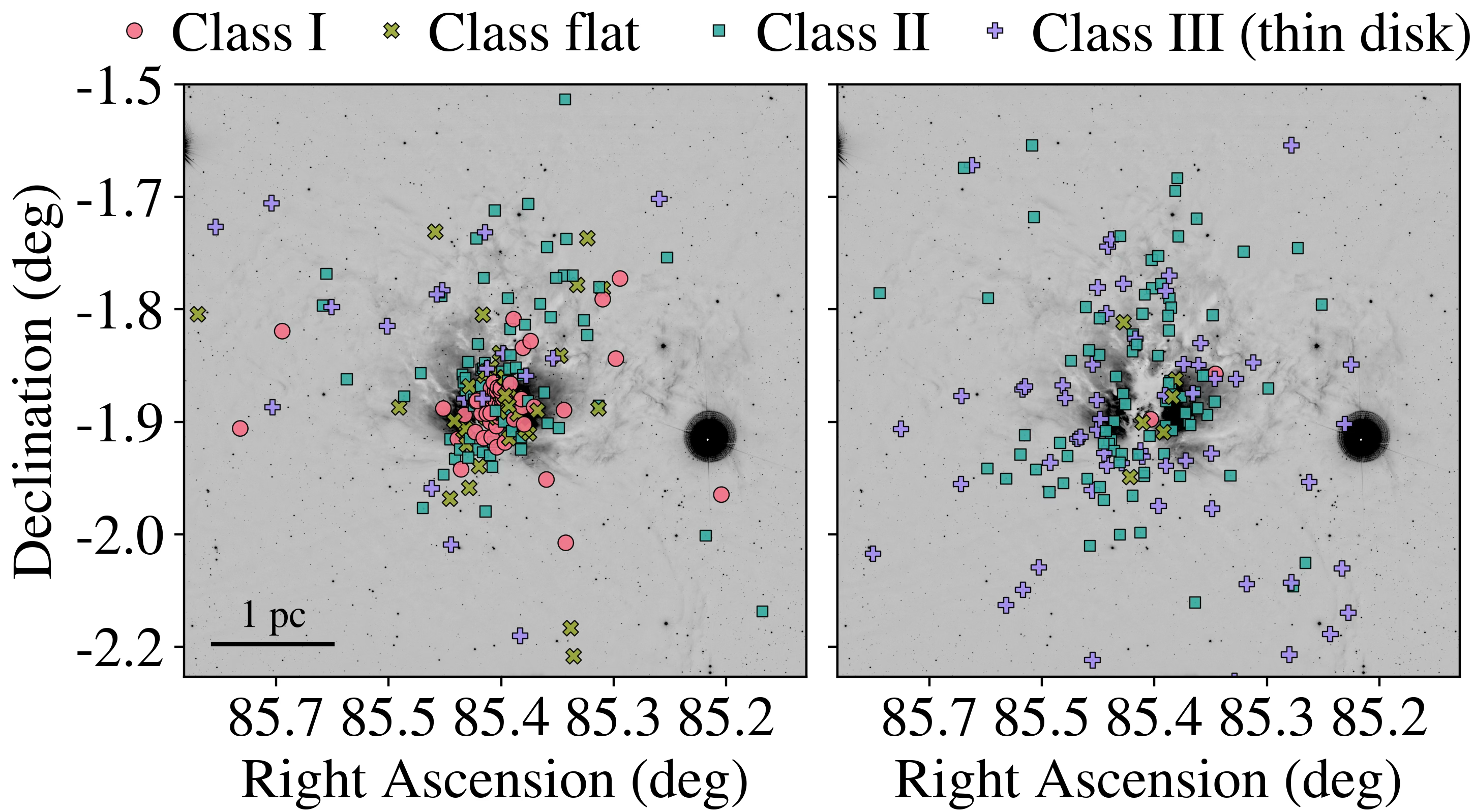
Using multi-epoch infrared observations, I measure proper motions of young stellar objects that are deeply embedded in their natal clouds and invisible at optical wavelengths. These measurements provide unique kinematic information for the youngest protostars, complementing Gaia's optical survey and letting us study the connection between young stars and their surrounding gas clouds.
Read the paperEmpirical isochrones for stellar populations
Cluster ages are central to tracing galactic structure and uncovering the star formation history of the Milky Way, but they remain notoriously model-dependent and uncertain. To create an independent alternative, I constructed empirical isochrones — purely observation-based reference curves — from high-quality Gaia photometry of well-characterized open clusters in the solar neighborhood. The result is an archive of empirical isochrones for 83 nearby clusters spanning roughly 7 Myr to 3 Gyr, which creates an age-scaling ladder for dating new stellar populations. Due to the exceptional precision of the underlying data, the archive also provides accurate lower-main-sequence isochrones for many clusters — a regime that is especially complex to model theoretically.
Read the paper